You’ll see nine Centers, 64 Gates and 36 Channels, along with numbers, lines and planetary placements.
It’s a lot.
Human Design is incredibly in-depth, and you can get into the weeds pretty quickly.
But what’s very cool about Human Design is that no matter how deep you go, it always comes back to your Strategy and Authority.
Those are some of the first things you learn, and ultimately they’re the foundation of actually experimenting with your design.
Before we get there, though, it helps to understand what all those shapes, numbers and lines on the BodyGraph actually mean.
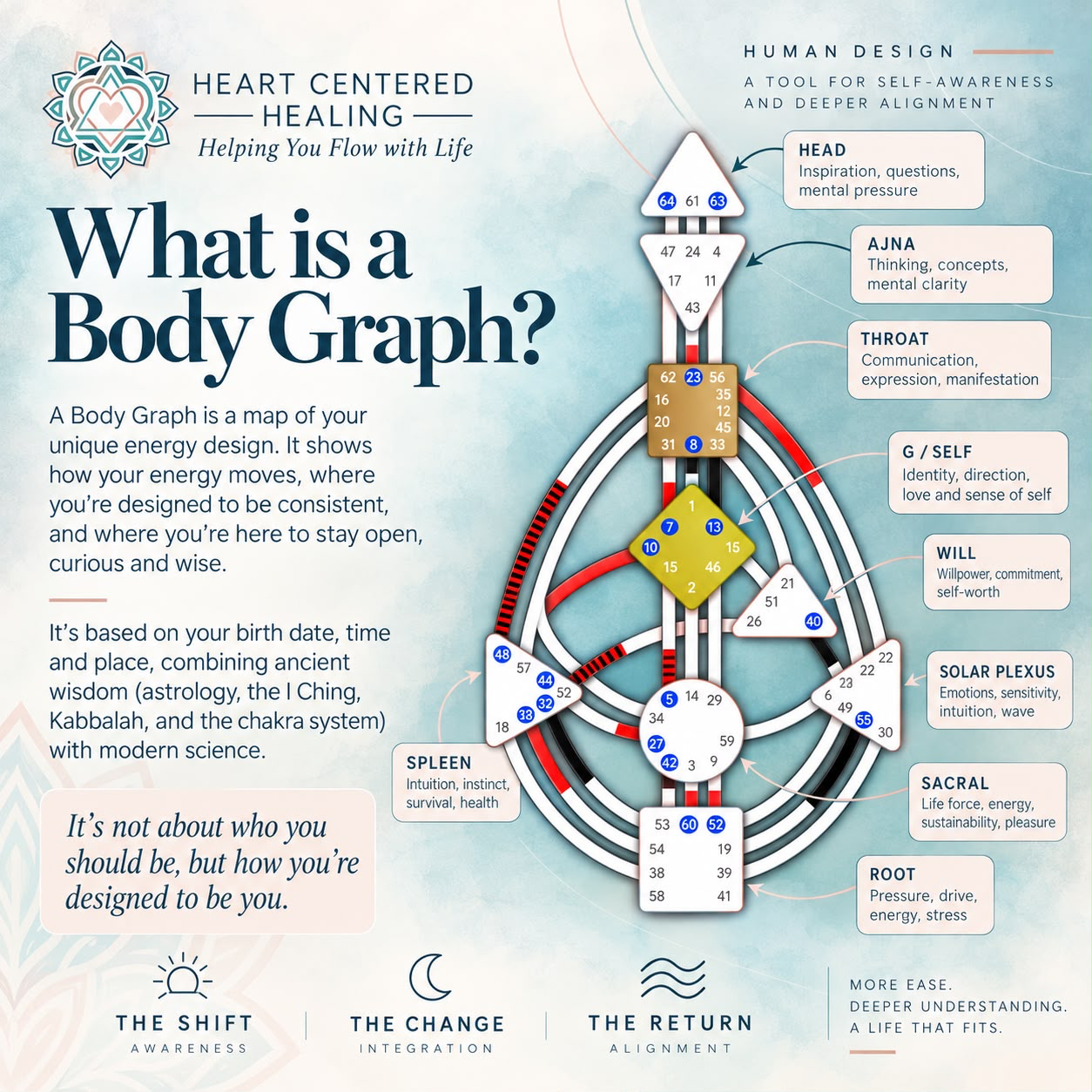
Sarah’s BodyGraph guide. Open the full image to read the small labels.
Graphic by Sarah Carpenter · View full image
Defined and Undefined Centers
The nine shapes you see in the BodyGraph are called Centers:
Head, Ajna, Throat, G Center, Heart/Ego/Will Center, Spleen, Sacral, Solar Plexus and Root.
You’ll notice that some Centers may be coloured in while others are white.
A coloured Center is called defined.
A white Center is undefined.
But what actually makes a Center defined?
This is where the Gates and Channels come in.
Gates and Channels: How Your Chart Gets Defined
Inside the Centers you’ll see numbers from 1 to 64. These are called Gates.
Your particular Gate activations are determined by the planetary positions used to calculate your Human Design chart.
Each Gate sits at one end of a potential Channel connecting two Centers.
Think of it a little like electrical wiring.
You can have one Gate activated on one side of a Channel without completing the connection. This is sometimes called a hanging gate.
But when the Gate at the opposite end of that same Channel is also activated, the two connect and create a defined Channel.
And once a Channel is defined, the Centers at both ends of that Channel become defined as well.
So, in very simple terms:
Activated Gates → connect to form Channels → defined Channels define Centers.
That’s how all those numbers, lines and coloured shapes begin turning into your particular BodyGraph.
So What Does “Defined” Actually Mean?
Your defined Centers represent energies and qualities that tend to operate consistently within you.
They’re part of the reliable energetic mechanics you bring with you.
Your undefined Centers work differently.
They’re places where you’re more open to taking in and experiencing energy from other people and your environment. In Human Design, we often talk about these areas as places where you can amplify what you’re taking in.
And this is important:
Undefined does not mean bad, weak or broken.
In fact, Human Design teaches that our undefined Centers can eventually become tremendous places of wisdom.
But they’re also some of the places where we’re most susceptible to conditioning.
If you repeatedly experience a particular kind of energy through other people, it can become very easy to assume that energy is yours — or that you’re supposed to be able to access it consistently.
You may even begin making decisions because of it.
And that’s where Human Design starts getting really interesting.
Because instead of asking, “What’s wrong with me?” you can begin asking:
“Is this actually mine?”
Sacral vs. Non-Sacral Beings
There’s another distinction you’ll hear me use a lot in Human Design: Sacral and non-Sacral beings.
The Sacral is one of the nine Centers in the BodyGraph and represents a powerful source of life-force, work and generative energy.
If your Sacral Center is defined, you are either a Generator or Manifesting Generator. Together, they make up the Generator family.
If your Sacral Center is undefined, you are a Projector, Manifestor or Reflector.
This distinction matters because Sacral and non-Sacral people simply aren’t designed to use energy in the same way.
Generators and Manifesting Generators have consistent access to Sacral energy. That doesn’t mean they have unlimited energy or should work themselves into the ground. Their Sacral is designed to respond to life rather than have the mind decide what it should pursue.
Non-Sacral Types don’t have that same consistent access to Sacral energy.
That doesn’t mean they have less value, less drive or less capacity.
Their energy mechanics are simply different.
And trying to keep up with the consistent Sacral energy of the people around them can become a major source of conditioning for non-Sacral beings.
Being a Projector I can tell you that this was life changing for me to find out! My whole life I was trying to work like a generator and I was burning myself out. Us non-sacrals will get away with functioning like generators until into our 30s and 40s. Then it catches up with you and it’s no small thing.
This is one of the MANY things I love about Human Design.
It starts taking us out of the idea that there is one “right” way to be productive, successful, decisive or energetic.
We’re not all built the same way.
And once you understand that, a lot of things you may have judged about yourself start making a whole lot more sense.
Human Design Is an Experiment
There is a lot more we will talk about in this series as we go over the basics so that when you decide to have your first reading, you will be able to understand so much more.
Your Type, Strategy, and Authority are the key players. And if you only ever learn that much, you’ll be so much further ahead.
Then we will get into Profiles, the Centers, Incarnation Cross’s and more.
But what’s great about HD is that you don’t need to understand all of it to begin your journey with it.
And you definitely don’t need to memorize your entire chart.
Human Design was meant to be experimented with.
You learn something about your design.
You try it out.
And then you pay attention to what happens.
- Where am I forcing something?
- Where am I trying to make a decision because somebody else thinks I should?
- Where am I trying to keep up with people whose energy works differently than mine?
- Where am I putting pressure on myself to be someone I was never actually designed to be?
- How does it play out when I say yes, when something in me is clearly saying no?
That’s where the deconditioning starts.
You’re not trying to become what your Human Design “says” you are.
You’re experimenting with what happens when you stop trying so hard to be who you thought you were supposed to be.
And little by little, you get to discover what was underneath all of that conditioning in the first place.
You.
The deconditioning you will start to do through understanding your human design is a process that will help you get back to who you truly are.
In the next post, we’ll take this foundation and look at the different Human Design Types — Generators, Manifesting Generators, Projectors, Manifestors and Reflectors — and the Strategy associated with each one.
Because even though Human Design can take you very deep, you don’t have to start deep.
You start with your Type, your Strategy and your Authority.
And then you experiment.
Explore Your Own Chart
If you would like to look at your own chart with Sarah, read about an Introduction Reading. If you are not sure it is the right fit, start with a free Discovery Call.